

Extending1 the methodology for hopping behaviors on Jerboa to Minitaur required understanding how to compose monopedal hopping primitives onto a quadrupedal robot. To do this, we built on the old idea of virtual bipeds, but in a way that would be compatible with the formal guarantees of the hybrid averaging framework that we had been publishing at about the same time:

Using simple bottom-up, decentralized, decoupled controllers, we were able to show a wide range of gaits working stably on Minitaur, with pretty good performance:
Virtual bipeds
The way we used the idea of virtual bipeds here was to “project” the coordinates roughly along the gray arrows, and “pair” the legs projected together.
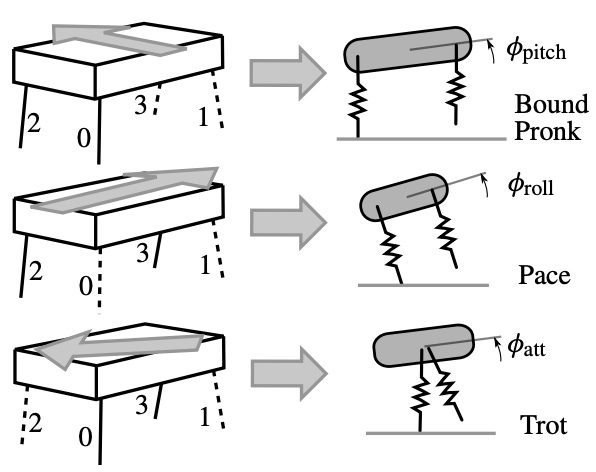
After this projection, we are left with a kind of planar bipedal system to analyze with three degrees of freedom, as shown in the right column above.
Vertical hopper compositions
Focusing on the bound/pronk projection, the types of limit cycles for these two gaits look like the flows roughly resembling the following picture:
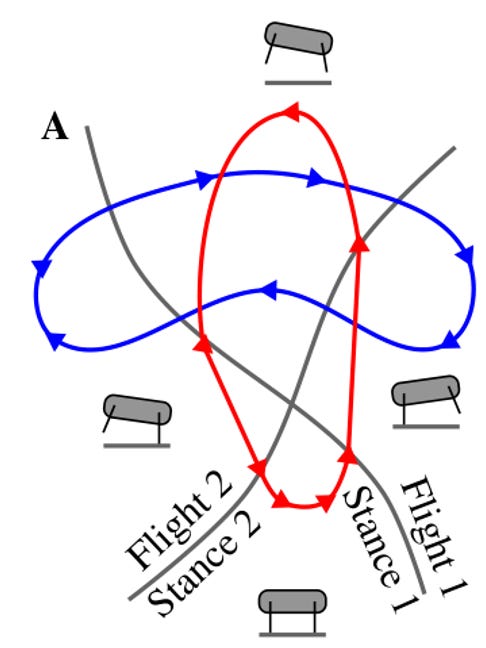
Looking more closely the picture above, the axes in the plot are the “phases” of the two legs, a concept we talked about in the accompanying hybrid averaging paper. That identification now encourages us to think about our original quadruped as a pair of (vertical) hoppers “coupled” by a body.
The “coupling” is physically instantiated by the body itself, and its inertia properties have a significant effect on the type of coupling. The center of percussion is a well-studied property of baseball bats, juggling clubs, etc. that relate impulses on one end of the object to the wrench on a different point along the object. We used this definition:
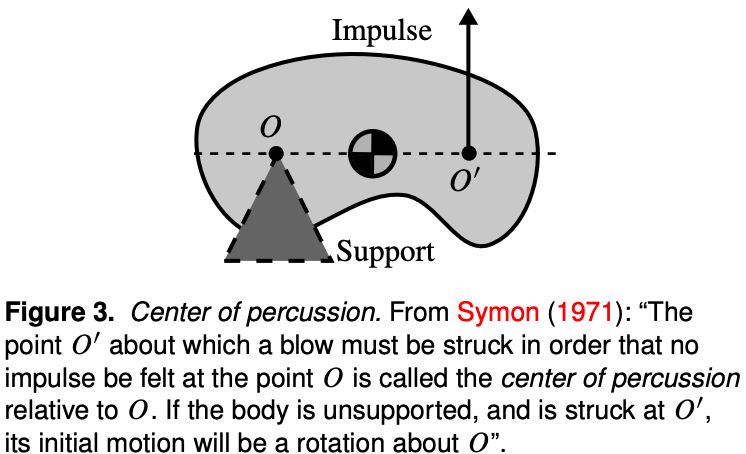
Intuitively, the location of the center of percussion, which is in turn related to the mass distribution of the object, affects the type of coupling between the two hoppers.
Pronking and bounding
We showed using simulation, and by physically altering the inertia characteristics of sagittal-plane Minitaur by adding an “inertia bar” to its back, that we could indeed get both bounding and pronking limit cycles by programming its front and rear ends as completely independent vertical hoppers:
This is a bit of an extreme interpretation of the style of decoupled control originally pioneered by Raibert and also demonstrated on Jerboa, but it also has interesting implications on the possibility of distributed control of legged robots. Another way to think about it is that we are formalizing preflexes, which have historically played a pivotal role in the mechanical stabilization of animal and robot locomotion.